
Puzzle Strike 2 marks a shift in my design thinking. My usual process has been to start with a mechanic or system, develop it, then later on develop the components and how it all looks in the box. A sensible order of events. But…something I’ve learned from user interface design is that if you want a slick user experience, then START with that. Have the underlying system and functions in mind, sure, but start with what you want players to ultimately see, touch, and do. Make it look good and feel good so that you can craft the underlying system specifically to end up pretty, elegant, and/or satisfying.
For example, if you need a few slots for cards in your game, choose the number of slots that will fit nicely on a board and look good, then design around that, rather than choosing a number with no consideration of how it’s going to look in the end, then later find out that you can’t make a nice looking board.
My Old Method:
Design game system -> components -> box tray layout.
My New Method:
Have a general notion of the game system -> develop components and box tray layout -> final version of game system that best uses the components.
So what is the game system I had in mind? And then what are the UI (user interface) things I wanted to achieve?
Crash System
I was lead designer of one version of Capcom’s video game Puzzle Fighter. The unusual comeback mechanics of Puzzle Fighter inspired me to make the tabletop game Puzzle Strike, and now about 14 years later, I have a completely different take on that same idea in the tabletop game Puzzle Strike 2.

In all these games, the core concept is the “crash gem” system. Briefly:
1) The more gems you have, the more powerful you are.
2) If you have too many gems then you lose the game.
3) “Crash gems” let you get rid of your own gems and send them to opponents.
That’s an interesting mix of forces that results in exciting back-and-forth moments being really common.
Starting at the End: Gems as Components
Given the premise of the crash gem system above, how do I hope the whole thing ends up? What should it look like and what should players do exactly? The stars of the show here are the gems, so shouldn’t they look like it? Let’s not just put pictures of gems on cards—let’s make awesome looking physical gems that you can touch and move around during the game. Furthermore, let's have four different types of gems so they can each have their own color and shape. That’s going to look great and have a fun physicality to moving the gems around so let’s start with those components in mind.

Having four different kinds of gems immediately has an implication of how the game system must be different from Puzzle Strike 1. In that game, you had only one type of gem (represented abstractly, not with physical gems). Puzzle Strike 1 uses an abstract mechanic of “combine” to join smaller gems into bigger gems.
If our components are going to have different colored gems, then it will make more sense if the game is about lining up same-color gems with each other. Rather than just imagining smaller gems combining, the player can physically arrange several, say, blue gems in a row. If that’s the goal, then we’re going to need some mechanic to help you rearrange gems. That’s “swap” in Puzzle Strike 2 (swap the position of two adjacent gems). So the decision to start with 4 different colors of cool-looking gems resulted in the having the mechanic of “swap”, rather than the other way around.
A Swap card with two swap icons on it. Each swap icon allows you to swap the position of two adjacent gems.

Swap
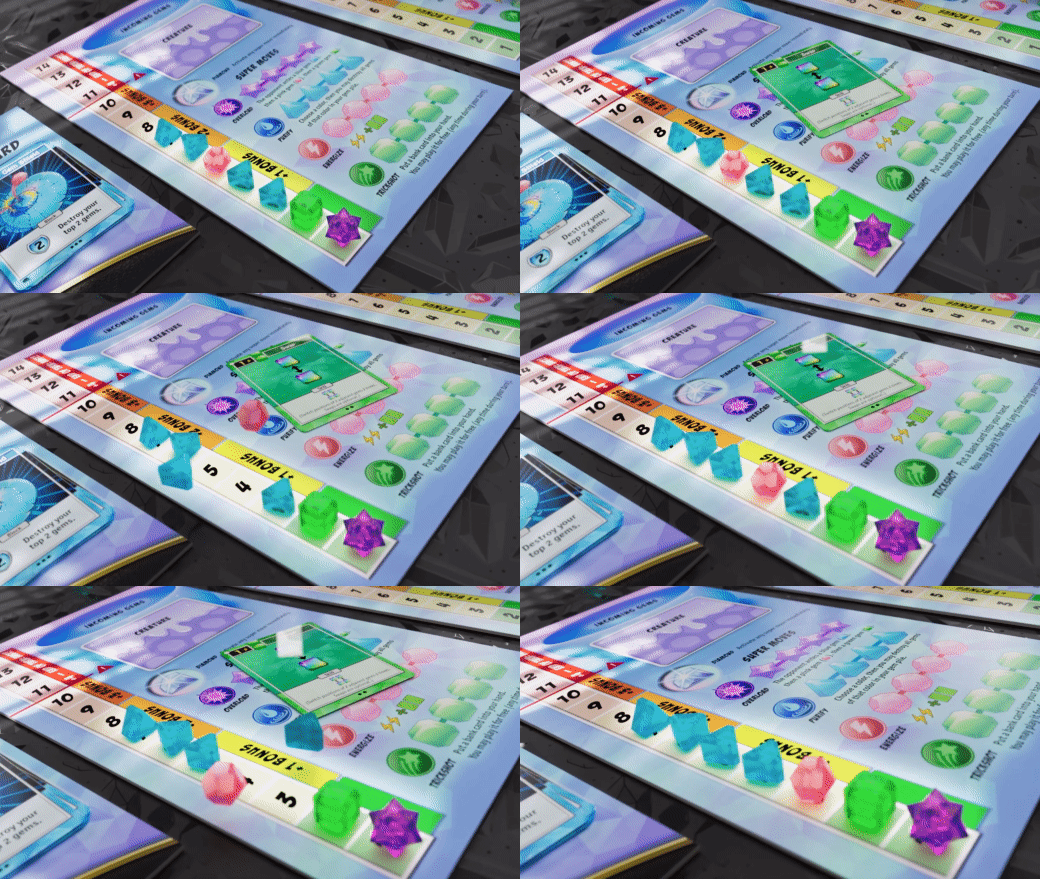
The point of lining up these colors is so you can “crash” them. In Puzzle Strike 2, crashing breaks your top gem AND all gems of the same color that are contiguous below it. Doing this fills up your super meter and also sends gems to opponents.
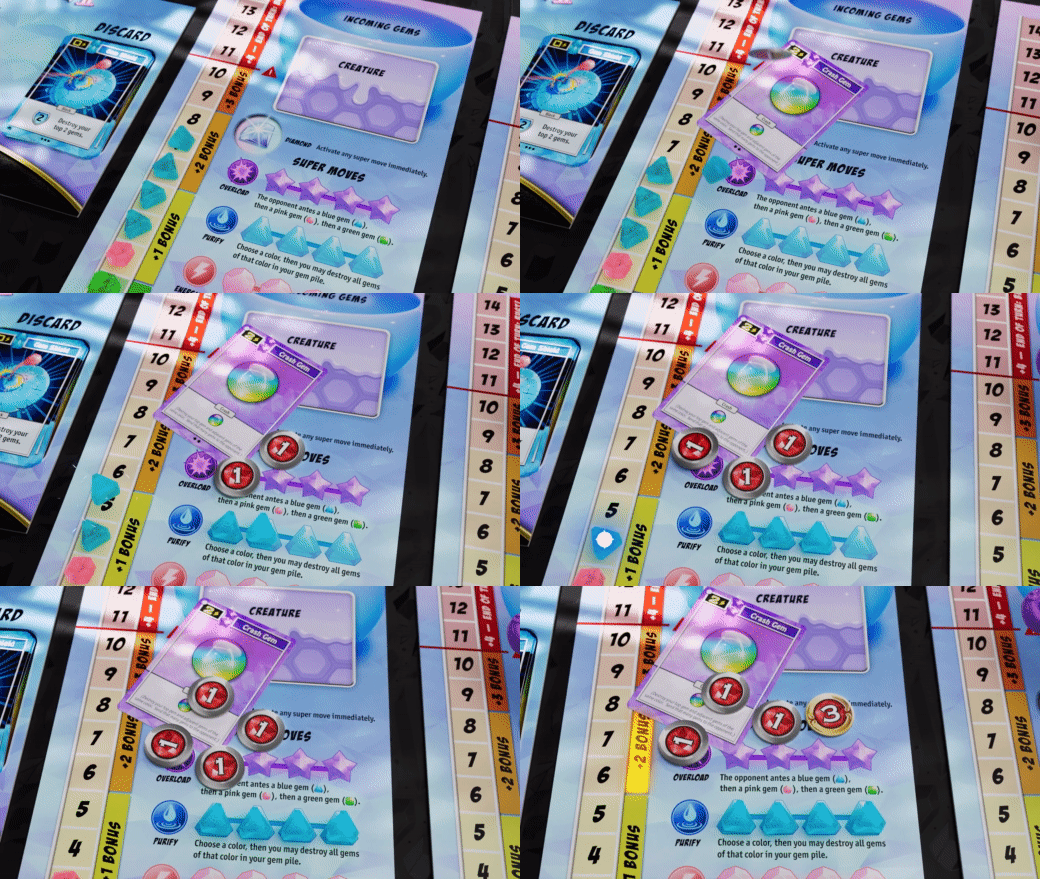
The crash gem breaks the top gem (blue) then all adjacent blue gems below it. They go into your super meter, then the same number of gems plus your “height bonus” are sent the opponent(s).
Starting at the End: Scepter as a Component
In this example, the component came out of a need from the design, but I still think there’s an element of “starting at the end” here.
Before even making the game, I established that I wanted most of the experience to be you solving your own puzzle. One way to enhance that is to make sure you can get through your whole turn without a bunch of back and forth waiting on your opponent to do things. Being able to get through your turn without back-and-forth with opponents also makes a game smoother and faster to play. And while we’re at it, we should have a targeting system that also lets you keep most of your attention on your own puzzle.
There’s nothing really wrong with how targeting worked in Puzzle Strike 1. When you break gems in that game, you just say which other player those gems go to. But is there some other way of doing things where you don’t even have to look at all the other players’ boards? Rather than think about the next step of “ok so how can that work?” I jumped ahead to “how do I hope that looks when it’s done?”
Puzzle Strike is inherently a test of greed. You get seduced by staying right at the edge of danger because it rewards you to do so, but if you push it too far then you just lose. So can we embody this in a physical object that also determines which player you send your gems to? The Scepter of Power was born.

I hoped that when this is all done, there would be a (cursed?) object that everyone wants that gives you even more power, but that also makes it even easier to lose. If that existed somehow, then it could be passed around and when you break your gems, you always send them to whoever has the scepter. The player with the scepter could send their gems to everyone at once. That’s flavorful and also solves a mechanical problem by making the system much easier to tune for different numbers of players than it would be if everyone sent gems to everyone all the time. It’s also nice that there’s no feel-bad of having to pick which specific person to attack (families will probably appreciate that part).
Anyway, the feeling of passing around this powerful object just felt spot-on. It took a while to work out the details of exactly how the rules work, but I got there. It adds a lot to the game and it might not have existed had I not started by thinking through the lens of how the final experience should look, and how tactile it should be.
Diamonds
When testing the Scepter, I realized that it inherently gives too much first turn advantage. The reason is that the benefits of holding the scepter for a while are good IF you can get away with it, and in the first few turns, it’s hard for opponents to really punish you enough for holding on to it. Many solutions were proposed. There’s no simple adjustment in rules that could address this because everything is so intertwined that “simple” changes to how the scepter works just end up breaking it.
So I thought “how do I hope this looks in the end?” I hope that in order to make up for not starting with the scepter, you start out with some other cool thing of your own. In Puzzle Strike 2, we have gems that you can move and touch, and a physical scepter to hold. It would feel cool if the players who don’t go first all get some other object...like a diamond. The diamond features prominently in the video game Puzzle Fighter, so it would be really flavorful if non-scepter players each started with a physical diamond.

It didn’t take long to figure out that “spend your diamond to activate any one of your super moves at any time” turned out to be the right power level. I know the above description sounds like the diamonds are some sort of band-aid, but that is not how they feel in the end. A band-aid in game design is a thing you wish you could remove, but can’t. In the case of diamonds though, players have told me several times that if they could remove them, they wouldn’t! They feel powerful and it’s fun to have a flavorful, tactile object that signifies you’re using your once-per-game super move cheat.
So now we have four kinds of gems, The Scepter of Power, and diamonds too. At this point, I was already designing the internals of the box to make sure all the components could be presented in a pleasing way, long before the overall design was done.

Some of the components in Puzzle Strike 2.
Drop Patterns
Puzzle Strike 2 is a deckbuilding game, by the way. One of many tabletop games where you start with a small deck, then add cards to it over the course of the game. The crash gem system is what really stands apart from other games while the deckbuilding part is the scaffolding.
The new mechanic of the “drop pattern” is where these two systems collide. Maybe it’s a small detail, but it’s one that practically every playtester talked a lot about, so it’s worth highlighting. There is a row of 5 cards in the community bank, and you add one of these to your deck each turn (and replace it with another card from the community deck). This is standard and done in a million tabletop games. What’s new though is that the order of the colors of those 5 cards determines the order of gems that will fall. That order is the “drop pattern”. Below, there is a drop pattern of pink, green, green, purple, blue. Three gems are falling so they become pink, green, and green (the first 3 colors in the pattern).

You add a card to your deck from the bank at the end of your turn, which means the order of colors that results from that is the order your next OPPONENT will have when their gems fall. This creates a tension in choosing which card to choose. One card might be good for your deck, but choosing it would leave a pattern of colors that’s just too easy for your opponent to line up and crash. Is it worth it? (Strategy hint: probably not! Don’t give your opponents lines of same-color gems!)
To make it even harder, if you choose the 3rd, 4th, or 5th card in the bank then you have to add 1, 2, or 3 incoming gem tokens to your own board. So you can get those cards, but you’re digging yourself in a potentially deeper hole later by doing so. (For example, if you choose the right-most card in the bank to add to your deck, it’s as if an opponent sent you 3 extra gems that you’ll have to deal with next turn.) These factors, both related to the gem system, add a lot of strategy to the deckbuilding part of the game.
Miracle Turns
Early in development, Puzzle Strike 2 games took a long time to play. They went on for many, many turns and had trouble reaching a conclusion. To address this, I tried turning defense down and the ability to do crazy combos up. As soon as we played this version, we knew it was pretty special.
Here’s what tends to happen. Everyone builds up for a few turns, but even those are dangerous and you could lose really fast (like on turn 2 or 3, even) if you aren’t careful. Very soon, things are spiraling out of control and someone sends a ridiculous number of gems. Remember that players lose if they end their turn with more than 10 gems, but they can have any number—like 50—before reaching the end of the turn. So it’s on them to scrounge up some miracle to get down to 10 or fewer gems before their turn ends.
Miracles happen. People with full gem piles are drawing several extra cards and are probably triggering multiple super moves per turn. Those super moves do a lot and can clear out gems, draw cards, give actions, and play cards for free. It’s pretty common for someone facing seemingly insurmountable odds to make that miracle and stay in the game. When they do, they almost certainly put someone else in “miracles or die” situation too. So the question is...how many miracles will be performed before someone just can’t keep it going? Probably between 0 and 3, but it’s a wild ride.
Here’s a quick note on strategy about The Scepter of Power that drives this home. If you have the scepter, the main benefit is that you’re getting a bunch of free super meter gain every turn, but the drawback is your defense is weaker. This leads to this amusing strategy situation:
If opponents aren’t sending that many gems to you: KEEP the scepter! Rack up that super meter.
If opponents are sending a lot of gems to you: GIVE UP the scepter! It’s too dangerous to hold onto it when you have weakened defense.
If opponents have sent a ridiculous number of gems to you, way way too many: KEEP the scepter! You’re in such deep trouble now that only miracles can save you, and if you want miracles, you probably need that extra super meter so see how it goes.
As soon as I felt these crazy dynamics (not just the scepter thing, but the whole game), we leaned into it and tuned around it. “Let it be the game of miracles,” I said.
The last mechanism I’ll mention is called “ante up” and plays into this as well. Though the game doesn’t usually have trouble reaching a conclusion, you really don’t want even 5% of games going on forever. So “ante up” is a way of addressing that in the most fun way. The game is already crazy and spirals out of control, but let’s crank it up over time to make sure it ends. By approximately your turn 4, then again on your turn 8 (could be sooner though), you start getting even more gems and more actions every turn. Things get so insane that they have to explode eventually, which makes for quite an exciting end, one way or another.

Once both Ante Ups have triggered, it means players get 5 actions per turn rather than the usual 3. And it also means players start their turns by adding 4 “ante” gems rather than just 2. The reason this is so good at pushing a game to conclusion is that ante gems are always the same color on a given turn, so can be broken with a single crash gem. For example, if the 5th card in the bank is green (and Ante Up x2 is in effect) then you’ll start your turn by adding four green gems on top of your gem pile—all in a row, just asking to all be crashed away. The height bonus means that breaking these is going to send MORE than 4 gems to opponents though, so we’re adding more and more gems to the system. Furthermore, breaking four gems of a given color ensures that color’s super meter triggers right away. This is so powerful that you just can’t sustain the back-and-forth much longer.
Fixed Decks
Puzzle Strike 1 lets you customize what appears in the bank each game, allowing for quadrillions of different starting conditions. The irony of those kinds of customizations is they often struggle to express as much variety as just a few carefully chosen designer-created options. Designers can make sure a cluster of mechanics (and theme!) goes together.
For example, if the designer creates a deck (rather than it being who-knows-what that players piece together), then a deck could potentially have some cards that give “birthday presents” (whatever those are) and other cards that trigger when you get “birthday presents”. But that second kind of card can’t really exist without the first, so it’s generally a bad idea to include in a customization-heavy game where one half of the combo might get left out entirely. In a game where a designer creates the decks, it’s easy to have each deck do totally different stuff and to ensure all the “parts of machine” are really in the deck.

A card that gives birthday presents and a card that triggers from that.
In Puzzle Strike 2, you simply pick which bank deck to play with. The base set has two decks and the expansion contains four more. They all play very differently and it’s handy for players that each deck has a different name, theme, and gameplay so that they can easily pick the type of bank deck they want before each game. This game probably had to use fixed decks anyway because each one needs an even mix of card colors for things to work well, but regardless of that, I like the kind of variety that designer-created decks bring.
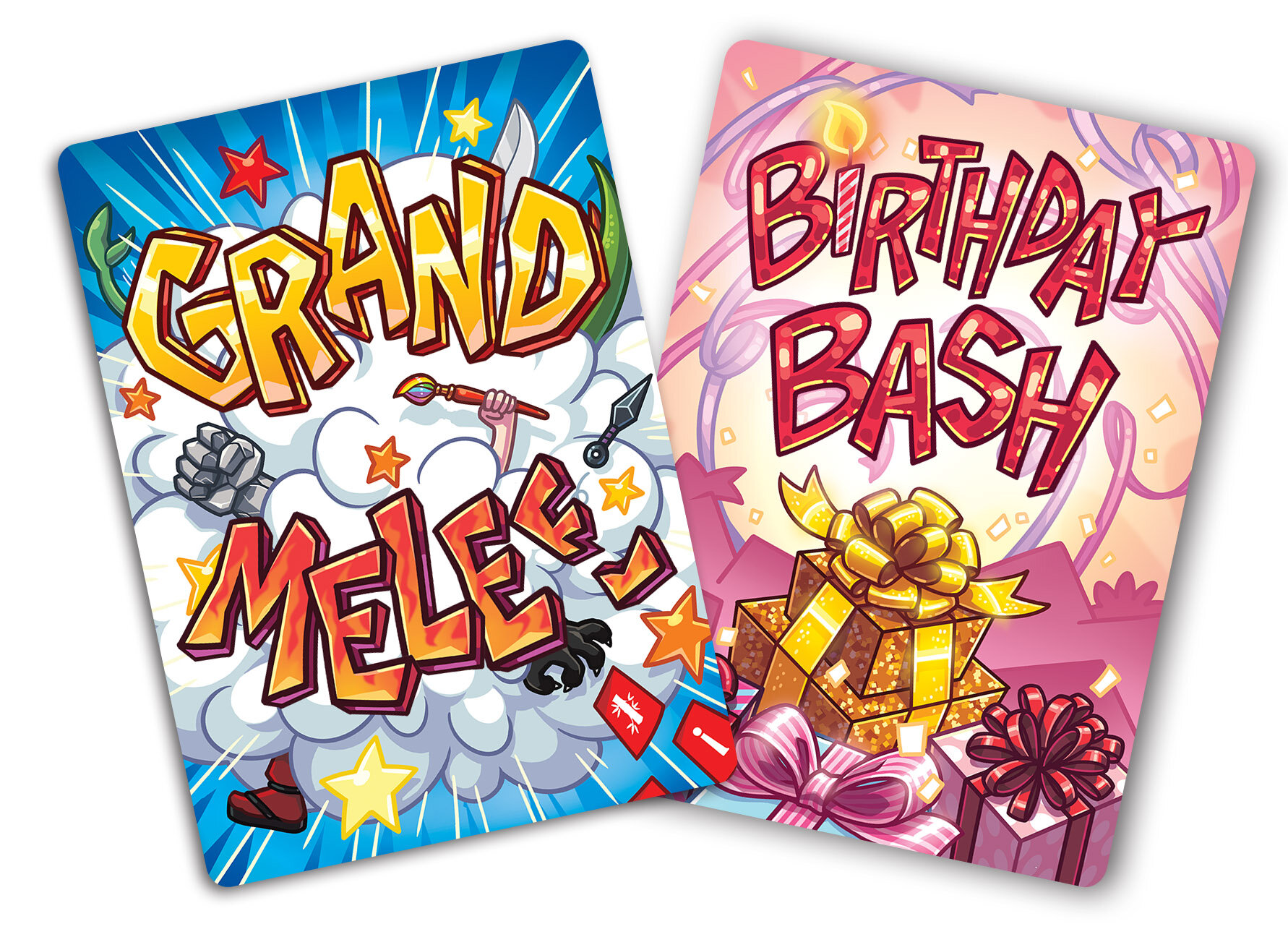
The two decks in the base set of Puzzle Strike 2.
How many decks should there be overall? I had the box design in mind right from the start here. Given a reasonable sized box, and all the cool components we’re putting in, what’s the maximum number of expansion decks that could all fit in there if we made it so the base set has room for the expansion? The answer is 4 additional decks (for a total of 6). That’s plenty. The “user interface” of the box being so good came from the idea of designing the content around what would physically fit, not the other way around. So I knew before making any base set decks or expansion decks that it would be 2 + 4 decks, and I was able to spread out the mechanics accordingly and I was able to make the box layout be elegant and pleasing.
Here’s a picture of the box’s tray. I’ve removed the 9 boards and rulebook so you can see the insert:

And here’s a picture from one of our players, showing what it looks like when the cards are sleeved and when the expansion cards are added to the base set’s box:

And here’s a look at everything that comes with Puzzle Strike 2:

Conclusion
The crash gem system that’s the core of Puzzle Strike is unique, wild, and strategic. It’s designed to make comebacks happen. More than ever though, it’s the components and the look-and-feel that really makes the game shine. The physicality of manipulating the gems, the pain of giving up The Scepter of Power, the rush of cashing in a diamond for a crazy combo. Though the game is a test of greed, it’s also a machine for miracle plays and memorable comebacks.
The tabletop version is available here. Play the virtual tabletop version on Screentop here.